Every year, the U.S. Mint produces billions of quarters. And every year, some of them come out wrong.
Die cracks, doubled images, extra metal, missing layers. These manufacturing errors turn ordinary 25-cent coins into collectibles worth hundreds or even thousands of dollars. The best part? They're still circulating. People spend them at gas stations and laundromats every day without a second look.
Here are five quarter errors that are realistically findable in pocket change, what they're worth, and exactly how to spot them.
1. 2004-D Wisconsin Extra Leaf Quarter ($3,000–$5,000)
This is the holy grail of modern quarter errors, and it's the one most likely to make you drop everything and check your coin jar.
The 2004 Wisconsin State Quarter features a cow, a wheel of cheese, and an ear of corn. On error specimens, there's an extra leaf on the corn stalk that shouldn't be there. Two varieties exist:
Extra Leaf High. The extra leaf points upward, roughly parallel to the existing leaf. Circulated examples sell for $90 to $280, with uncirculated specimens reaching $500 to $1,500+ depending on grade.
Extra Leaf Low. The extra leaf curves downward. Slightly scarcer, circulated examples bring $55 to $215, with high-grade uncirculated coins selling for $400 to $1,200.
In top uncirculated grades (MS-66 and above), both varieties have sold for several thousand dollars at major auction houses.

How to spot it: Look at the corn stalk on the reverse. Normal Wisconsin quarters have one leaf on the left side of the ear of corn. Error coins have a clear, distinct second leaf, either pointing up or curving down. You can see it without magnification, but a loupe helps confirm it.
Why it's valuable: The error is believed to have been caused by a die gouge at the Denver Mint. An estimated 50,000 error coins were produced before the die was pulled, making them scarce but not impossibly rare.
2. 1999-P Delaware Spitting Horse Quarter ($100–$500)
The first State Quarter ever released also produced one of the most popular errors. Look at the horse on the 1999 Delaware quarter, and on error specimens, a die crack runs from the horse's mouth, making it look like the horse is spitting.
The die crack creates a raised line of metal extending from the horse's jaw area. Some collectors call it the "Spitting Horse" and others call it the "Drooling Horse." Either way, clear examples sell for $5 to $25 in circulated condition, with uncirculated specimens reaching $30 to $75 depending on the prominence of the crack.
How to spot it: Examine the horse on the reverse with a loupe. Look for a raised line running from the mouth area downward or outward. The more pronounced the crack, the more valuable the coin.
Also Read
3. 2005-P Minnesota Doubled Die Quarter ($200–$1,000)
The 2005 Minnesota State Quarter has a well-documented doubled die error that shows extra tree lines on the reverse design. Minnesota's design features a lakeside scene with trees, and on doubled die specimens, the trees show clear doubling, essentially a shadow image slightly offset from the main design.
Some specimens also show doubling on the inscription text. The best examples, with strong, visible doubling across multiple elements, sell for $100 to $300 in uncirculated condition. Minor doubling specimens in circulated grades bring $20 to $75.
How to spot it: Focus on the tree trunks and branches on the reverse. Under 10x magnification, you'll see a distinct shadow or second impression slightly offset from the main image. The lettering on the reverse may also show doubling.
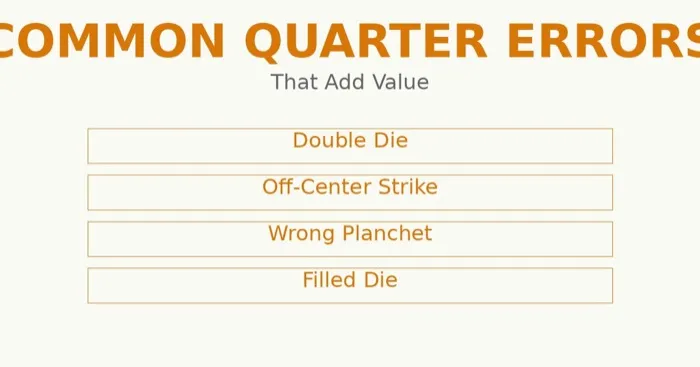
4. Off-Center Strike Quarters ($50–$3,000+)
Off-center strikes happen when the coin blank isn't properly aligned in the press. The result is a coin where the design is shifted to one side, leaving a blank crescent of unstamped metal on the opposite edge.
The value depends on two factors: how far off-center the strike is, and whether the date is still visible.
| Off-Center % | Date Visible? | Approximate Value |
|---|---|---|
| 5 to 10% | Yes | $50 to $150 |
| 15 to 25% | Yes | $150 to $500 |
| 25 to 50% | Yes | $500 to $3,000 |
| 50%+ | Yes | $3,000 to $10,000+ |
| Any % | No | $20 to $75 |
The key rule: the date must be visible for maximum value. A 50% off-center quarter with a readable date is a showpiece. The same coin without a visible date is worth a fraction.
How to spot it: This one's obvious. If your quarter looks lopsided with a blank crescent on one side, you've found an off-center strike. Measure the off-center percentage by estimating how much of the design is missing.
5. Broadstrike Quarters ($25–$500)
A broadstrike occurs when a quarter is struck outside the collar die, the metal ring that gives quarters their reeded (ridged) edge. Without the collar, the metal spreads outward freely, creating a coin that's wider than normal with a smooth edge instead of reeding.
Most broadstrike quarters sell for $25 to $100. Dramatic examples where the coin is significantly wider than normal can bring $200 to $500. State Quarter broadstrikes tend to command a premium because of the collector crossover between error collectors and State Quarter collectors.
How to spot it: The coin will feel slightly larger and thinner than a normal quarter. The edge will be smooth (no ridges). The design will look stretched or spread toward the edges. Compare it to a normal quarter side by side and the difference in diameter is usually noticeable.
Also Read
How to Check Your Coins Like a Pro
You don't need expensive equipment to coin roll hunt. Here's the minimal setup:
A 10x jeweler's loupe ($8–$15 on Amazon). This is non-negotiable. Most errors are visible at 10x magnification, and many are visible to the naked eye, but the loupe lets you confirm what you're seeing.
Good lighting. A desk lamp with a daylight LED bulb positioned at an angle to the coin. Tilting the coin under angled light reveals die cracks, doubling, and surface anomalies that flat overhead light hides.
A reference source. Bookmark PCGS CoinFacts or download the NGC Coin Explorer app. When you think you've found something, compare your coin to confirmed error images.
Where to look. Bank-rolled quarters are the most efficient source. You can buy rolls ($10 per roll, 40 quarters each) from your bank and search them. Return searched rolls to a different bank branch to avoid re-searching the same coins.
What to Do If You Find One
If you think you've found a valuable error quarter, follow these steps:
Don't clean it. Cleaning a coin destroys its surface and can cut the value by 50% or more. Leave it exactly as you found it.
Get a second opinion. Post clear, well-lit photos on r/coins or the CoinTalk forums. Experienced collectors can usually identify errors from photos.
Consider professional grading. For coins potentially worth over $500, submit to PCGS or NGC for authentication and grading. Grading costs $30–$65 per coin but graded coins sell for significantly more than ungraded examples. A PCGS-graded Wisconsin Extra Leaf quarter is worth double or triple what the same coin brings raw.
Sell strategically. Heritage Auctions is the top venue for high-value errors. For coins under $500, eBay with detailed photos and accurate descriptions works well. Local coin shops are fast but typically offer 50–70% of retail value.
The Bottom Line
Quarter errors are one of the most accessible entry points in coin collecting because the coins are literally everywhere. You handle them every day. The Wisconsin Extra Leaf alone has turned up in cash registers, parking meters, and coin jars years after it was minted.
The odds of finding a major error are low on any given day, but they're not zero. And at 25 cents per coin, the downside of looking is nothing. The upside is a coin worth months of rent.
Start with the Wisconsin quarters. Check every 2004-D quarter you encounter. It takes three seconds and could be worth five thousand dollars.
Sources
Written by
Thomas Whitfield
Numismatic Correspondent covering rare coins and mint errors.