In 1943, the United States Mint did something it had never done before and has never done since. It made pennies out of steel.
The reason was simple: copper was needed for the war. Every shell casing, every mile of communications wire, and every piece of military equipment required copper, and the U.S. was burning through the stuff at an unprecedented rate. So the Mint coated thin steel blanks in zinc and stamped over a billion pennies that looked more like dimes than cents.
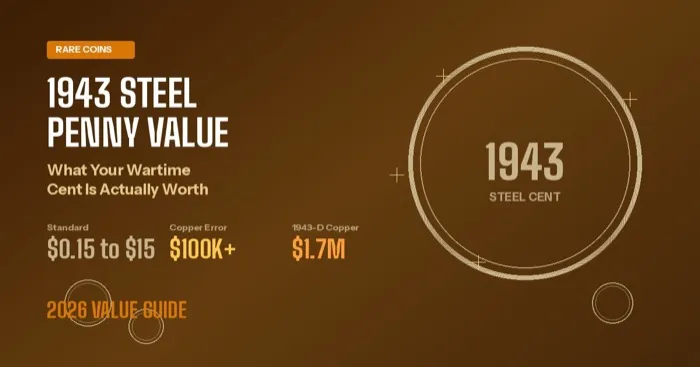
Most of those steel pennies are still around today, tucked into jars, coin folders, and shoeboxes across the country. If you have one, you are probably wondering the same thing everyone wonders: is it worth anything? The short answer is that most 1943 steel pennies are worth well under a dollar. But certain varieties, errors, and mint marks can push values into the hundreds, thousands, or in a few legendary cases, over a million dollars.
Here is the complete guide.
What a Standard 1943 Steel Penny Is Worth
Let's set expectations first. The U.S. Mint produced over 1 billion steel pennies in 1943 across three facilities. These are not rare coins in the traditional sense.
| Mint Mark | Mintage | Circulated Value | Uncirculated (MS65) |
|---|---|---|---|
| No mint mark (Philadelphia) | 684,628,670 | $0.10 to $0.50 | $11 to $20 |
| D (Denver) | 217,660,000 | $0.10 to $0.50 | $12 to $25 |
| S (San Francisco) | 191,550,000 | $0.15 to $0.75 | $11 to $19 |
Total mintage: 1,093,838,670 coins.
At lower grades, these pennies are worth a modest premium over face value. The real money starts at MS66 and above, where certified examples can bring $26 to $45. At MS67, a 1943 S penny has sold for $338 to $563. At the very top, MS68 examples are genuinely scarce and have sold for $3,360 to $5,250 at recent auctions.
The all time record for a standard 1943 steel penny is $138,000, paid in January 2014 for a PCGS MS67 1943 S specimen.
The Million Dollar Error: 1943 Copper Pennies
Now for the coin that makes headlines. In 1943, a small number of pennies were accidentally struck on leftover copper blanks from 1942. These "wrong planchet" errors are among the most famous and valuable coins in American numismatics.
How many exist? Only about 20 to 26 confirmed examples across all three mints.
- Philadelphia (no mint mark): approximately 20 specimens
- San Francisco (S): 5 specimens
- Denver (D): 1 specimen (the only one known to exist)
| Variety | Known Examples | Value Range | Record Sale |
|---|---|---|---|
| 1943 Copper (Philadelphia) | ~20 | $100,000 to $500,000 | $372,000 (2019, Heritage) |
| 1943 S Copper | 5 | $200,000 to $600,000 | $504,000 (Heritage Auctions) |
| 1943 D Copper | 1 | One of a kind | $1,700,000 |
The unique 1943 D copper penny is the rarest small cent in American history. It sold for $1.7 million in a private transaction and is graded MS64 Brown by PCGS.
The Reverse Error: 1944 Steel Pennies
When the Mint switched back to copper in 1944, the same accident happened in reverse. A handful of steel blanks were left in the press hoppers and got struck with 1944 dies. These are just as dramatic as the 1943 coppers and nearly as rare.
Known examples: roughly 25 to 40 across all three mints.
| Variety | Known Examples | Value Range |
|---|---|---|
| 1944 Steel (Philadelphia) | ~25 to 30 | $75,000 to $200,000 |
| 1944 D Steel | ~7 | $100,000 to $300,000 |
| 1944 S Steel | 2 | $200,000 to $408,000 |
The 1944 S steel penny is the rarest of the group with only 2 confirmed examples. One sold for $408,000 in 2021.
Other 1943 Errors Worth Looking For
Beyond the famous copper errors, there are several die varieties and striking errors that carry premiums.
1943 D Repunched Mint Mark (FS 501). The "D" mint mark on this variety was struck twice, creating a visible doubled effect. This is ranked number 8 on the list of most wanted Lincoln cent varieties. Values start around $50 in Good condition, $100 or more in Extremely Fine, and $400 or more in MS63. A MS67 example sold for $10,000 in 2022.
Doubled Die Obverse. Some 1943 steel cents show doubling on the obverse lettering, particularly on "LIBERTY" and "IN GOD WE TRUST." These are one of the strongest doubled die varieties in the Lincoln wheat penny series. Significant premiums apply depending on the strength of the doubling and the coin's grade.
Off Center Strikes. High volume wartime production led to more misfeeds than usual. Off center 1943 steel cents, where the design is shifted to one side, sell for $25 to $200 or more depending on how far off center the strike is. Coins struck 10% to 50% off center with a visible date are the most desirable.
How to Tell If Your 1943 Penny Is Real
The 1943 copper penny is one of the most counterfeited coins in the hobby. People have been copper plating steel pennies and filing down 1945 and 1948 dates for decades. Here is how to authenticate what you have.
The magnet test (most important). Hold a magnet near the coin. A genuine 1943 steel penny sticks to the magnet. If it does not stick, you either have one of the extremely rare copper errors or, far more likely, a fake.
The weight test. A genuine 1943 steel penny weighs 2.70 grams. A genuine copper penny weighs 3.11 grams. A copper plated steel penny will still weigh around 2.70 grams and stick to a magnet.
Examine the date. Counterfeiters often modify the last digit of other dates (usually 1945 or 1948) to make them look like 1943. Under magnification, a genuine "3" on a 1943 penny has an unusually long tail. Look for tool marks, uneven surfaces, or signs that metal has been scraped or added around the date.
The sound test. Drop the coin onto a hard surface. A steel penny makes a dull thud. A copper penny makes a distinct ringing sound.
If your coin passes these tests and you believe it might be a genuine 1943 copper error, the next step is professional grading. Send it to PCGS or NGC for authentication. Do not clean it, polish it, or handle it without gloves.
Recent Auction Results (2024 to 2026)
The market for high grade 1943 steel cents remains active. Here are notable recent sales.
| Coin | Grade | Sale Price | Year |
|---|---|---|---|
| 1943 Steel Cent | PCGS MS68+ | $14,400 | 2025 |
| 1943 Steel Cent | PCGS MS68 CAC | $4,560 | 2024 |
| 1943 Steel Cent | PCGS MS68 | $3,360 | 2024 |
| 1943 Steel Cent | PCGS MS68 | $3,360 | 2025 |
| 1943 D Repunched MM | MS67 | $10,000 | 2022 |
| 1943 S Steel Cent | PCGS MS67 | $563 | Recent |
The takeaway: standard circulated examples will not make you rich. But if you have a well preserved uncirculated specimen, professional grading can unlock surprising value.
What to Do If You Find a 1943 Penny
Step 1: Check the magnet. If it sticks, you have a steel penny. If it does not stick, proceed very carefully because you may have something extraordinary (or a fake).
Step 2: Examine the condition. Look for rust, scratches, and wear. Uncirculated coins with original surfaces are worth significantly more than cleaned or corroded examples.
Step 3: Check the mint mark. Look on the obverse (front), below the date. No letter means Philadelphia. "D" means Denver. "S" means San Francisco.
Step 4: Get it graded. If the coin appears to be in uncirculated condition (no wear on Lincoln's cheekbone and hair), or if it might be a copper error, send it to PCGS or NGC for professional certification. Grading fees typically start around $20 to $40 per coin.
Step 5: Do not clean it. This is the single most important rule in coin collecting. Cleaning a coin, even gently, permanently damages its surface and can cut the value by 50% or more. Leave it exactly as you found it.
If you are interested in exploring more valuable coins that might be sitting in your pocket change, take a look at our guide to rare quarters worth money in 2026.
Why the 1943 Steel Penny Still Matters
Eighty three years after they were minted, 1943 steel pennies remain one of the most recognized and collected coins in the hobby. They are a tangible connection to World War II, affordable enough for beginners to own, and just rare enough at the top grades to reward serious collectors.
The coin itself tells a story: a country at war, redirecting its resources, and finding a creative workaround to keep commerce running. That combination of history, accessibility, and the tantalizing chance of finding a million dollar error is what keeps collectors coming back to the 1943 steel penny year after year.
Sources
Written by
Thomas Whitfield
Numismatic writer and ANA member covering rare coin values and collecting strategies.